
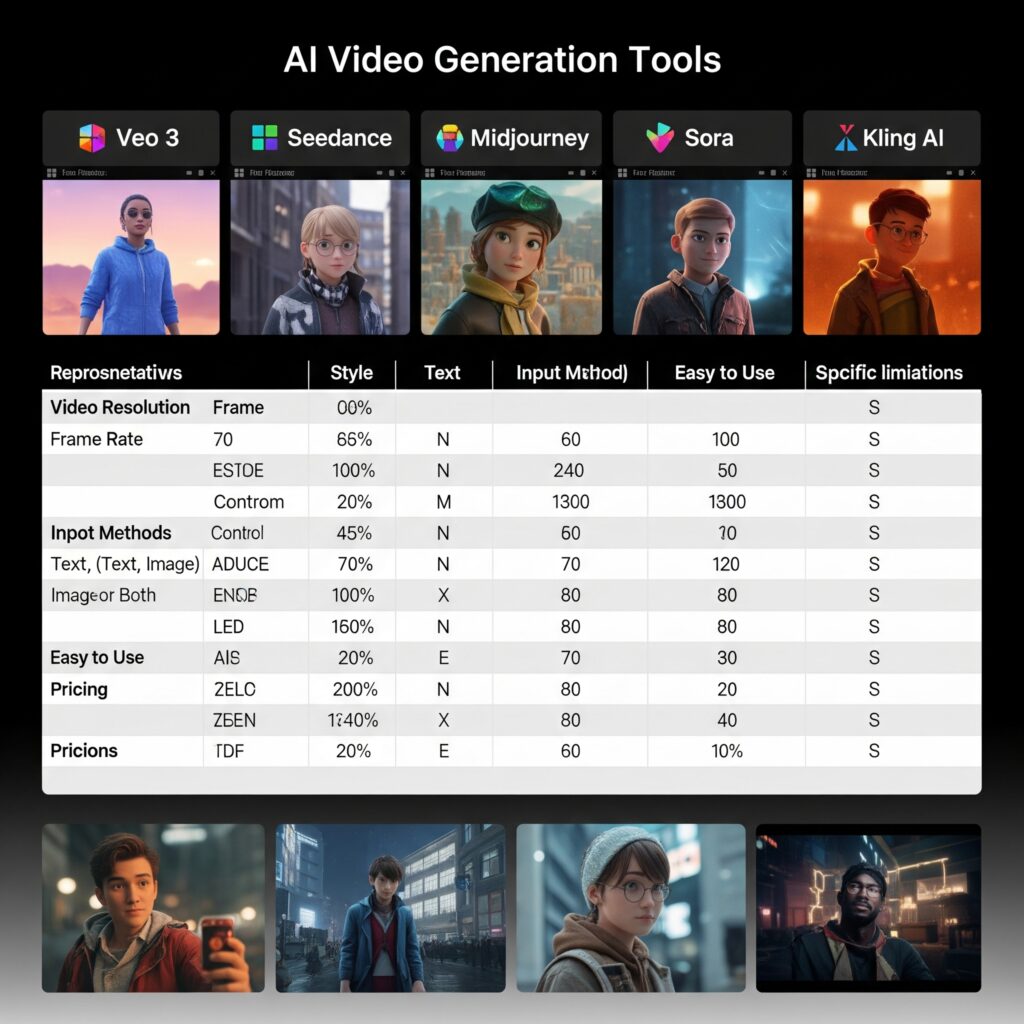
Veo 3, Seedance, Midjourney, Sora, Kling AI & More!
The world of video creation is undergoing a seismic shift, powered by incredible advancements in Artificial Intelligence. What once required extensive resources, specialized skills, and hefty budgets can now be conjured with a few lines of text or a single image. We’re witnessing a “reel revolution,” and at the forefront are innovative tools like Google’s Veo 3, ByteDance’s Seedance, OpenAI’s Sora, Midjourney’s burgeoning video capabilities, and Kuaishou’s Kling AI, alongside other impressive contenders such as Luma Dream Machine, Haiper, and Morph Studio.
Let’s dive into how these groundbreaking platforms are transforming the landscape of video production and what sets them apart.
The Dawn of AI Video: What’s Changed?
Just a short while ago, AI video generation was largely experimental, producing short, often glitchy clips. Today, we’re seeing:
- Unprecedented Realism: AI models are now capable of generating highly realistic visuals, from intricate textures to believable human and object movements, often referred to as stepping “out of the uncanny valley.”
- Enhanced Prompt Adherence: The AI understands complex textual prompts with greater accuracy, translating your vision into precise visual narratives, including nuanced actions and camera movements.
- Longer, Cohesive Scenes: We’re moving beyond short bursts to multi-shot storytelling, with improved consistency in characters, styles, and transitions across extended clips.
- Integrated Audio: The most advanced tools are now incorporating native audio generation, adding sound effects, ambient noise, and even dialogue that syncs perfectly.
- Creative Control: Users are gaining more granular control over camera movements, artistic styles, and even character consistency through reference images and detailed prompting.
A Closer Look at the Leaders:
1. Google Veo 3:
Google has stepped into the ring with Veo 3, a formidable contender focused on high-fidelity and realistic output, announced at Google I/O 2025.
- Key Features: Veo 3 excels in native audio generation, automatically adding synchronized sound effects, ambient noises, and even dialogue with realistic lip-syncing. It boasts impressive physics-based video simulation for natural motion and visuals. With multi-input prompts, you can guide generations with both text and image references, and it promises 4K output and videos up to 60 seconds long. It’s accessible via Google’s paid AI plans (Google AI Pro and Google AI Ultra) within Gemini and the new “Flow” AI filmmaking tool.
- The Edge: Its seamless integration of high-quality visuals with perfectly synced audio sets it apart, making it a powerful tool for filmmakers and storytellers looking for realistic, sound-rich generations.
2. Seedance (ByteDance Seed):
From the creators of TikTok, ByteDance’s Seedance 1.0 emphasizes cinematic aesthetics and multi-shot storytelling.
- Key Features: Seedance is praised for its smooth and stable motion and native multi-shot storytelling, maintaining consistency in the main subject, visual style, and atmosphere across shot transitions and temporal-spatial shifts. It offers diverse stylistic expression, allowing for photorealism, cyberpunk, illustration, and more. Its precise prompt following enables complex action sequences and nuanced camera control. It’s often highlighted for its speed and efficiency in generating high-definition video.
- The Edge: Seedance prioritizes narrative flow and visual consistency across multiple shots, making it ideal for crafting structured video content, particularly short-form narratives. It’s recognized for its strong performance in prompt adherence and motion quality.
3. Midjourney (with its new Video Feature):
While primarily known for its stunning image generation, Midjourney has recently rolled out its video capabilities, turning static images into dynamic clips with its V1 Video model (launched June 2025).
- Key Features: Midjourney’s video feature allows users to animate existing AI-generated images or uploaded pictures into short videos (currently 5 seconds, with options to extend up to 20 seconds). Users can choose between “low motion” for subtle movements and “high motion” for more dynamic camera and subject movement. It operates on a credit-based system, similar to its image generation. Future versions (V7) promise higher resolutions (HD, 4K, 8K potential), timeline editing, motion paths, and enhanced 3D rendering.
- The Edge: For existing Midjourney users, it offers a familiar workflow to bring their captivating images to life, making it an excellent extension of their creative toolkit. Its focus on image-to-video provides a unique entry point for animation and is noted for its affordability compared to some rivals.
4. OpenAI Sora:
OpenAI’s Sora, though not yet widely available to the public, has demonstrated astonishing capabilities in generating highly realistic and coherent videos from text prompts.
- Key Features: Sora is known for its ability to generate complex scenes with multiple characters, specific types of motion, and accurate details of the subject and background. It demonstrates a deep understanding of how things exist in the physical world, leading to realistic physics and object interactions. It can produce videos up to 60 seconds long (20 seconds for ChatGPT Plus/Pro users) at 1080p resolution and offers features like re-cutting, remixing, and looping.
- The Edge: Sora’s most significant advantage is its unparalleled realism and coherence over longer durations, effectively “solving” temporal consistency challenges that plagued earlier AI video models. Its ability to maintain character identity and physics across complex scenes sets a new benchmark. Access is currently limited to ChatGPT Plus, Team, and Pro users.
5. Kling AI (by Kuaishou):
Kling AI, developed by the Chinese company Kuaishou, is making waves with its cinematic camera movements and lifelike human motion.
- Key Features: Kling AI generates videos in 1080p resolution at up to 30 frames per second (with 4K in testing). It excels in generating realistic characters and motion, offers cinematic camera controls (pan, zoom, dolly), and supports both text-to-video and image-to-video inputs. A key feature is its lip-sync technology, allowing for realistic dialogue. It also offers frame control for precision storytelling and the ability to extend shots.
- The Edge: Kling AI stands out for its emphasis on realistic human motion and dedicated lip-sync capabilities, making it particularly useful for character-driven content and virtual presentations. Its accessible free tier and various paid plans offer flexibility for different user needs.
Other Noteworthy Players in the AI Video Arena:
- Luma Dream Machine: This tool focuses on generating high-quality, realistic shots from text and images with impressive speed. It emphasizes character consistency, natural camera movements, and the ability to maintain physical accuracy in its generated videos.
- Haiper: This platform provides efficient text-to-video and image-to-video conversion, aiming for high-quality, realistic, and stylized outputs. It’s designed for ease of use, making it accessible for various creators.
- Morph Studio: An AI video creation and editing platform that combines text-to-video, image-to-video, and style transfer features. It offers a storyboard-like workflow, allowing for individual shot generation and camera direction changes.
The Future is Moving:
These advancements are more than just technical marvels; they represent a fundamental shift in how content is produced. From marketing agencies creating dynamic ads in minutes, to independent filmmakers prototyping complex scenes, to educators developing engaging animated lessons, the democratization of video creation is here.
While each tool has its unique strengths – be it Veo 3’s integrated audio, Seedance’s multi-shot narratives, Midjourney’s image-to-video prowess, Sora’s cutting-edge realism, or Kling AI’s lifelike characters and lip-sync – the overarching trend is clear: AI is making high-quality video accessible, fast, and incredibly versatile. As these models continue to evolve, we can expect even more sophisticated control, longer durations, and increasingly indistinguishable AI-generated content.
The reel revolution has only just begun, and the possibilities for visual storytelling are now, more than ever, limited only by imagination.
If you are looking for a partner to integrate AI into your business, don’t hesitate to reach us via info@aioniostech.com